
Summer 1
We are looking forward to another exciting and rewarding term in Koala Class, with lots of opportunities for the children to learn, discover, and grow. Our learning journey this term will include a range of inspiring topics designed to encourage independence, creativity, and a love of learning. Through practical experiences, collaborative activities, and thoughtful discussions, the children will be encouraged to explore new ideas, build confidence, and develop their skills across the curriculum. We will also continue to strengthen our core understanding in English and Maths, helping every child to build secure foundations for future learning. Please see below for an overview of the main areas of learning and key experiences planned for the term ahead.
English
The Bear and the Piano By David Litchfield (Fiction: Narrative)
This three-week unit immerses children in the enchanting story of The Bear and The Piano, a beautifully illustrated tale about a bear who discovers a piano in the forest and sets out on a journey of music, friendship, and self-discovery. Through the story, children will explore not only the magic of narrative but also the joy of writing their own imaginative stories.
The unit is designed to build on children’s existing transcription skills while encouraging them to become confident young writers. Children will learn to craft sentences that are detailed, expressive, and correctly punctuated. They will practice using proper nouns, exclamation marks, and question marks, as well as using adjectives to bring characters and settings to life. The story provides rich opportunities to explore singular and plural nouns, introduce simple past tense, and extend sentences using and to add more detail and interest.
By the end of the unit, children will have written their own short narratives inspired by the Bear’s adventures, demonstrating increasing independence and accuracy in their writing. The unit emphasizes creativity, storytelling, and a love of language.
By the end of the unit, children will write a short narrative based on The Bear and The Piano, applying all foundational transcription skills they have previously learned. Children will:
- Use capitals for proper nouns (e.g., Bear, Piano, the names of places).
- Use exclamation marks for emphasis.
- Use singular and plural nouns correctly.
- Begin using simple past tense consistently (e.g., played, went, discovered).
- Increase accuracy in punctuating sentences with full stops and question marks.
- Use adjectives to describe nouns (e.g., beautiful piano, big bear).
- Extend sentences using the conjunction and to add detail.
Expected Writing Outcome Example:
The Bear found a big piano in the forest! He played it every day. The animals came to listen. The birds and the rabbits danced. One day, the Bear went to the city. He saw many pianos. The kind people clapped and cheered! The Bear played all the pianos and made new friends. He returned to the forest and shared his music with everyone. The animals danced and sang happily. The Bear loved playing his piano and making everyone smile.
La Luna -Pixar Short Film (Non-Fiction: Recount)
In this unit, children will watch the short film La Luna and learn how to write a recount about what happens in the story. They will focus on retelling the events in order and using the writing skills they have already learned. Children will practice using capital letters for names, punctuation marks such as full stops, question marks, and exclamation marks, and adjectives to describe nouns. They will also work on using singular and plural nouns correctly, connecting ideas with ‘and’, and writing verbs in the simple past tense. By the end of the unit, children will be able to write a clear recount of the story, showing their understanding of both the events and the characters.
By the end of this unit, children will be able to write a recount of the events in La Luna. Children will apply all foundational knowledge for transcription they have already learned and will:
- Use capital letters for proper nouns (e.g., Luna, Papa, Grandpa).
- Use exclamation marks for emphasis.
- Use singular and plural nouns correctly.
- Introduce simple past tense verbs to recount events (e.g., climbed, helped, watched).
- Increase accuracy in punctuating sentences, including question marks.
- Use adjectives to describe nouns (e.g., bright moon, small boat).
- Extend sentences using ‘and’ to connect ideas.
Expected Writing Outcome Example:
Yesterday, I watched a short film called La Luna. It was about a small boy called Bambino. He went to the sea with his Papa and Grandpa.
Bambino climbed the big boat with them. He watched the bright moon and the shiny stars. Then, he helped his Papa and Grandpa to clean the stars. He used a long broom and a small brush.
Bambino worked hard and felt happy and excited. He wondered why the stars were falling. He learned how to clean the stars by himself at the end.
Bambino’s night was fun and amazing! I liked watching him because he tried very hard and did a great job.
Maths
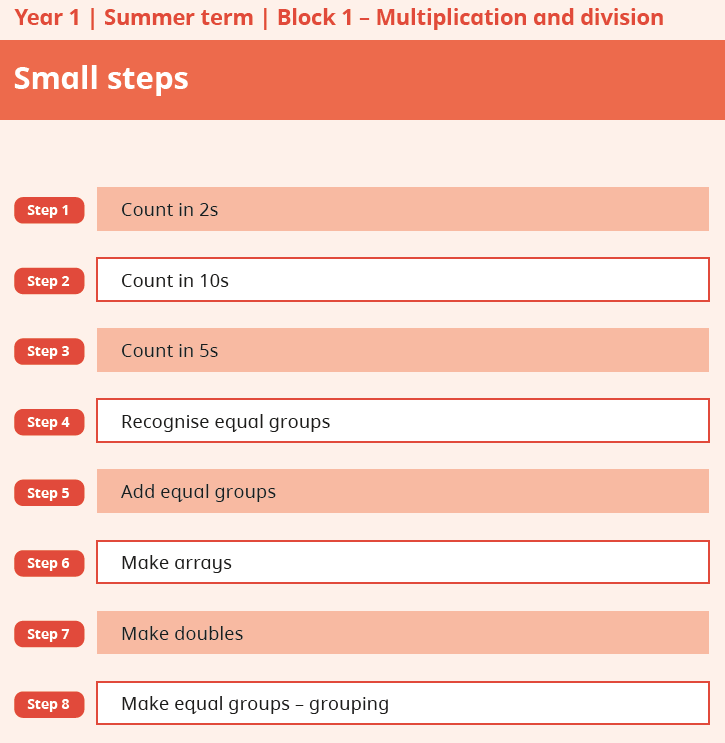
Multiplication and Division

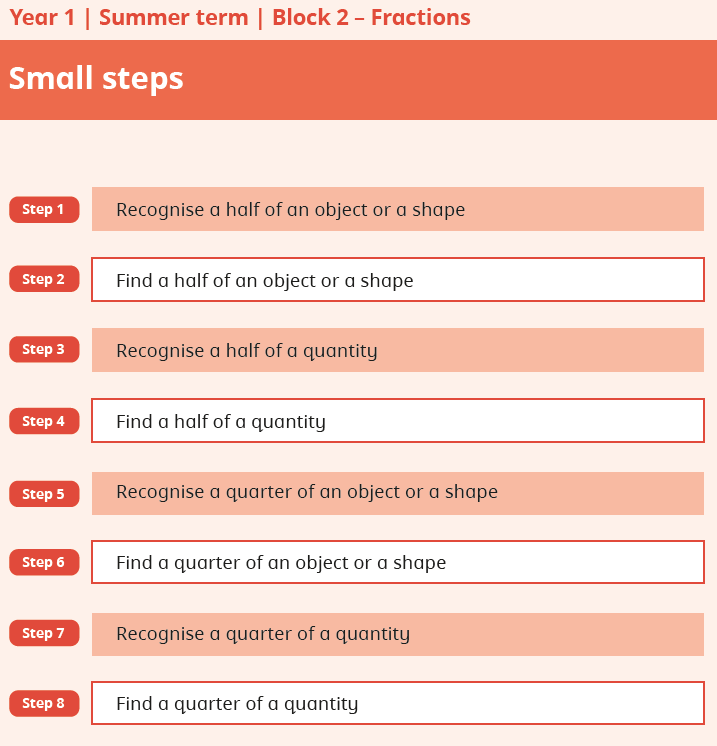
Fractions
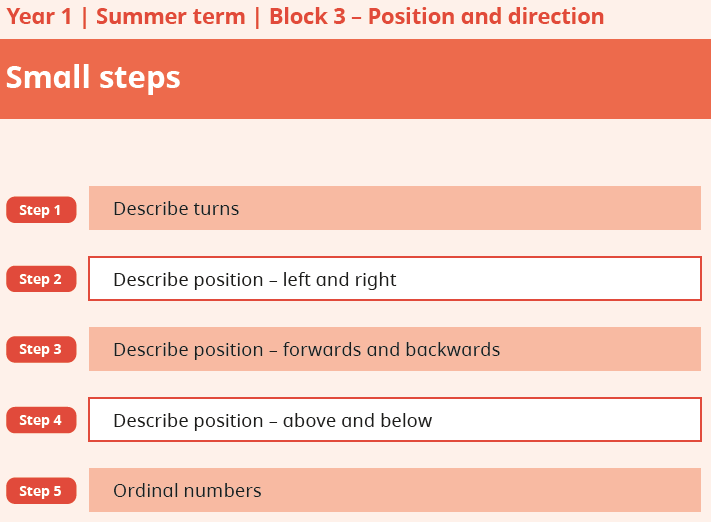
Geometry - Position and Direction
Science - Plants: An introduction to Plants
Identifying and naming a variety of plants and investigating if beans need water for growth.
Unit Outcomes
Pupils who are secure will be able to:
- Identify plants and their features.
- Recall some of the roles that flowering plant parts have.
- Name some trees and their parts.
- Identify similarities and differences between deciduous and evergreen leaves.
- Recall that seeds and bulbs come from plants.
- Recognise that seeds need water for growth.
When working scientifically, pupils who are secure will be able to:
- Raise questions about plants and respond to suggestions on how to set up an investigation to answer a question.
- Use a magnifying glass to observe the different parts of flowering plants.
- Draw and label a diagram of a flowering plant.
- Use an identification chart to name flowering plants.
- Sort plants into groups based on specific criteria.
- Use non-standard units to measure leaf length.
- Recognise similarities and differences in seeds and bulbs.
- Recognise that predictions do not always match observations.
- Identify which plant parts can be eaten.
- Recognise that scientific research into plants leads to important discoveries.
History - How have explorers changed the world?
Identifying explorers past and present and what makes them significant.
Unit Outcomes
Pupils who are secure will be able to:
- Explain what explorers do
- Name equipment or transport an explorer would need.
- Sequence four photographs from different periods of time.
- Name important explorers (e.g. Christopher Columbus, Dame Ellen MacArthur, Matthew Henson and Mary Kingsley).
- Identify where they travelled and what they achieved.
- Select the most important events in a historical story.
- Sequence events on a timeline and use this to retell the story.
- Describe what they can see in a photograph.
- Make inferences about an image and ask questions to further their understanding.
- Recall information about past and present exploration.
- Understand events in relation to the present day and compare how exploration has changed over time.
- Describe how an explorer is significant and how they impacted events or people’s ideas.
- Show understanding of significant people by designing a coat of arms.
Art and Design - Painting and Mixed Media: Colour Splash
Learning about primary and secondary colours, colour mixing techniques and applying these skills in painting and printing.
Unit Outcomes
Pupils who are secure will be able to:
- Name the primary colours.
- Explore coloured materials to mix secondary colours.
- Mix primary colours to make secondary colours.
- Apply paint consistently to their printing materials to achieve a print.
- Use a range of colours when printing.
- Mix five different shades of a secondary colour.
- Decorate their hands using a variety of patterns.
- Mix secondary colours with confidence to paint a plate.
- Describe their finished plates.
Music - Pitch (Theme: Superheroes)
Learning how to identify high and low notes and to compose a simple tune to represent a superhero.
Unit Outcomes
Pupils who are secure will be able to:
- Identify high and low notes.
- Perform high and low notes.
- Create and perform a two-note and three-note pattern.
- Identify and perform changes in tempo.
- Contribute musical ideas and cooperate within a group.
- Prepare and perform a musical piece.
- Demonstrate a musical understanding of tempo and pitch.
- Participate in discussions about pitch and tempo.
- Offer feedback to groups on their performance.
- Follow instructions during a performance.
PSHE - Economic Well-being
Unit Outcomes
Pupils who are secure will be able to:
- Explain how children might get money.
- Explain some different ways to keep money safe.
- Discuss the role of banks and building societies.
- Recognise that people may make different choices about spending or saving.
- Explain that a range of jobs exist in and out of school and that different skills are needed for jobs.
Computing - Creating Media: Digital Imagery
Developing photography and image editing skills to capture photos to create an adventure story.
Unit Outcomes
Pupils who are secure will be able to:
- Plan a pictorial story using photographic images in sequence.
- Explain how to take clear photos.
- Take photos using a device.
- Edit photos by cropping, filtering and resizing.
- Search for and import images from the internet.
- Explain what to do if something makes them uncomfortable online.
- Organise images on the page, orientating where necessary.
Online Safety
How much time should we spend on technology?
Exploring how to balance the time spent engaging in online and offline activities.
PE
This term children will be developing their PE skills and knowledge in Net and Wall Games and Sending and Receiving.